WARNING: long post, lots of pics
I got back today from my trip to Cuzco. Yesterday was such an amazing day that I was too overwhelmed last night to write about it. In summary, we went to visit microfinance clients of our local partner organization in Pisac and Chincheros. All of them were artisans: a silversmith who makes his own jewelery, a carver and potter who makes exquisite bowls from wood and clay, a man who carves and paints beautiful board games and pieces and also makes clay pottery, and others. It was amazing to talk to them all about how they were able to improve their lives with the microfinance loans. Their intelligence, talent, and persistence really impressed me.
I spent like it was the last day of money. My colleagues made fun of me, but how can you not support people like our microfinance clients? They earned my respect, and my soles, with their hard work and beautiful products. The first place we went was the artisan market at Pisac. It was thronged with tourists of all stripes, the good, the bad, and the painful, but you should go there. Buy a bowl from Benturino and a game from Roger. You won't regret it. Ask them about microfinance.
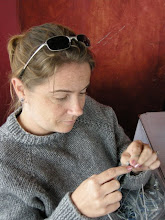
 Then, after lunch, we went to Chincheros, where we first met a woman whose name I believe is Matilda. She has sheep, she shears them, washes and cards the wool, spins it, and then dyes it with all natural dyes. She is lively and smart and funny and talented. To the left, she is showing us a hat that she is working on, which is knit on the finest yarn I've ever seen someone using for a hat (like lace weight if you are Barbie) on five of the tiniest needles, which were more like pins, thin rudimentary metal sticks, than like the Addi Turbos some of us claim we can't live without. Stunning color work.
She also showed us some of the yarns she was drying and the things she used for creating the dye. To the right, the bags have green leaves (top), next to the yarn that was dyed using those leaves (chillca), and cochineal (bottom), which makes a beautiful red. Matilda also weaves some really nice traditional Chincheros pattern weavings out of alpaca and wool. She sold me the mountain of natural, un-dyed wool at the bottom for 10 soles, or about $3.00.

After spending some time with her, we went to see two of the most amazing people I've met here: Adrian and Antonia Huaman. These two remarkably talented weavers are also microfinance clients of our local partner organization. And they, for me, are exemplars of what well-implemented microfinance can do for people. Originally, Adrian wove pictorial tapestries and Antonia sold them at a tourist restaurant. Then, they got a loan, and invested it in wooden looms, which they built themselves, and in hiring some younger boys to work with Adrian. Now, from that profit, they have a number of different kinds of looms, both of them make stunning weavings and tapestries in traditional Chincheros patterns, they employ about 10 people, and they bought a new house where they plan on opening a restaurant and gallery, where tourists can not only eat traditional Andean food (yum), but can also learn to weave and purchase beautiful weavings with a deeper appreciation of the tradition and talent that goes into each one.

Antonia's mother gave us a demonstration of how to ply yarn in the traditional way with a hand spindle. I'll have a movie of this, hopefully, sometime soon, so you can see her in action. It is amazing.
 Adrian and Antonia showed us their weavings. They make table runners (yes, I bought one, and you should look for the ones that have the borders on them), and tapestries and handbags and purses. It takes 36-40 days to make a table runner, which they can sell to a tourist for around $50. The runners are made with the backstrap loom method, and the scraps of each are saved and used to make dolls and other small items, like change purses. Antonia told me about the dyes that she uses:
 Cochineal - reds

Antonia's mother gave us a demonstration of how to ply yarn in the traditional way with a hand spindle. I'll have a movie of this, hopefully, sometime soon, so you can see her in action. It is amazing.
 Adrian and Antonia showed us their weavings. They make table runners (yes, I bought one, and you should look for the ones that have the borders on them), and tapestries and handbags and purses. It takes 36-40 days to make a table runner, which they can sell to a tourist for around $50. The runners are made with the backstrap loom method, and the scraps of each are saved and used to make dolls and other small items, like change purses. Antonia told me about the dyes that she uses:
 Cochineal - reds
 Flor de Colli - yellows
 Cacasuncay and Motemote - browns and pinks, respectively
 and Awaypile - fuscia
Adrian and Antonia also showed us their hand-made looms, and showed us how they work. It was really impressive -- check out all those bobbins hanging from Antonia's loom! Crazy-making. Adrian makes the pictures from his head now, but he first paints the designs on the warp (?) threads, so that when they cross over the weft (? sorry if I'm not using the right words, weavers), they don't stand out as white, but blend in. He does some huge tapestries, with really elaborate pictures, wrapping little bits of colored unspun wool into place deftly.


So, the haul. Below, first picture:
a chess game, a parchesi game (from Roger in Pisac), a hand-painted clay mug (also from Roger, a gift!), two hand-painted wooden bowls from Benturino, baby alpaca yarn (oh, gotta tell you about that...), and a belt, called a faja.

 Second picture:
a table runner from Antonia, the wool from Matilda, and a little change purse which was a gift from Adrian and Antonia.